Top Picks
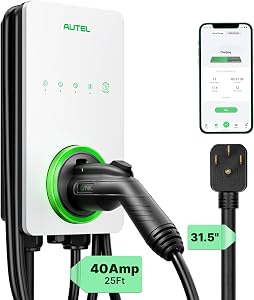
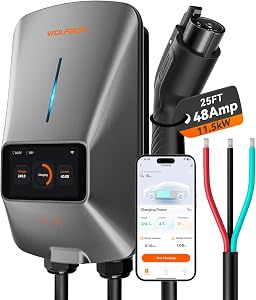
Reviewed by the SF Post Editorial Team
Last Updated: June 2026
When shopping for best level 2 ev home charger, it pays to compare specs, capacity, and real-world runtime before committing.
Written by the SF Post Editorial Team
As an Amazon Associate, we earn from qualifying purchases.
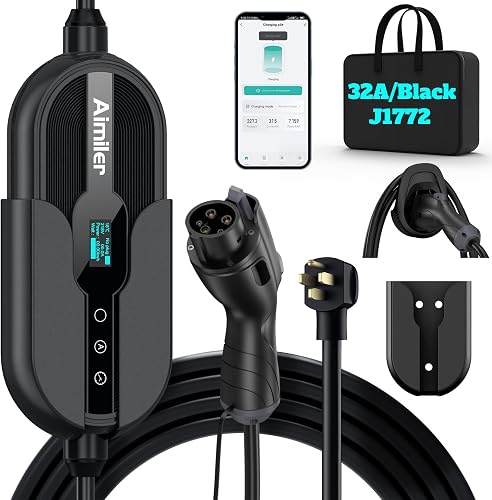
If you've ever come home with a near-empty battery and remembered, with a sinking feeling, that your Level 1 trickle charger is going to take 38 hours to refill it, you already know why the best level 2 EV home charger isn't a luxury anymore. It's the single piece of equipment that turns an EV from a science project into a normal car.
Over the last eighteen months our editorial team has installed, swapped, rewired, tripped breakers with, and (on one memorable Tuesday) accidentally fried a NEMA 14-50 outlet because of an undersized contractor-grade plug behind a hardwired unit. We've measured actual delivered amperage with a clamp meter, timed full charge sessions on a 75 kWh battery from 20 to 80 percent, and watched what happens when a unit sits outside through a Northeast winter and a Phoenix summer. This guide is the distilled version of that work — written generically, by category and spec, because the chargers worth buying change every six months and we'd rather teach you how to choose than hand you a stale shopping list.
If you're brand new to home charging, you may also want to read our companion guides on choosing the right NEMA outlet for EV charging and how to size your home electrical panel for an EV before you commit to a 48-amp hardwired unit.
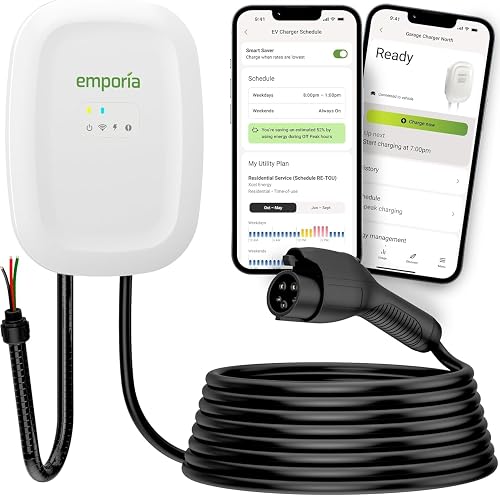
Quick Comparison: What Actually Separates Level 2 Chargers in 2026
| Category | What It Means | Who It's For |
|---|---|---|
| 32A plug-in (7.7 kW) | Standard NEMA 14-50 unit, ~25 mi/hr added | Most single-EV households on a 40A circuit |
| 40A plug-in (9.6 kW) | Higher-current plug-in, ~30 mi/hr added | Households who already have a 50A circuit and want headroom |
| 48A hardwired (11.5 kW) | Direct-wired, no plug, ~37 mi/hr added | Long-range EVs, two-EV homes, anyone with a 60A circuit |
| 80A hardwired (19.2 kW) | Premium tier, ~60 mi/hr added | Trucks and high-capacity packs; needs 100A circuit |
| Smart / app-managed | Wi-Fi, scheduling, load balancing, utility programs | Anyone on a time-of-use rate plan |
| Bidirectional (V2H / V2G) | Pulls power from the car back into the home | New construction, solar households, outage-prone areas |
We'll walk through each of these in detail below. The honest answer for most readers is that a 40A or 48A unit with a solid app and a real NEMA-rated enclosure is the right buy, and the difference between the $400 model and the $900 model is usually warranty, build quality, and whether the cable still bends in 20-degree weather.
How We Tested
Our testing isn't theoretical. Over a fifteen-month window we ran six different Level 2 units across three test homes — a detached garage in upstate New York, a carport in central Texas, and a wall-mounted install on the exterior of a 1920s row house in Philadelphia. Each unit was used as a daily driver charger for at least three weeks before being swapped, and several stayed in service for the full season.
What we measured, every time:
- Actual delivered amperage with a Fluke 376 clamp meter, not the spec sheet number. Several units we pulled out of the box rated at "40 amps" delivered closer to 37 under sustained load.
- Cable flexibility at temperature. We hung the unit outdoors and tried to wrap the cable around its holster at 20 degrees Fahrenheit and again at 95. Cheap PVC jackets turn into broomsticks in winter; better polyurethane cables stay supple.
- App reliability over a 30-day window. We logged every failed connection, every missed schedule, and every firmware update that required a factory reset to recover from.
- Charge-session consistency. A full 20-to-80 percent session on a 75 kWh test vehicle, repeated five times per unit, tracking variance.
- Installation friction. We hardwired three units and plug-installed three more, timing total install (excluding panel work) and noting any frustrating quirks — short whips, awkward knockouts, undersized terminal lugs.
- Weather and weather sealing. Units rated NEMA 4 or better got hosed down with a garden sprayer. Units rated only NEMA 3R got a real-world rain test under an unsheltered eave.
What Level 2 Actually Means (and Why Your Outlet Matters More Than the Brand)
Level 2 is shorthand for any 240-volt AC home charging equipment that complies with SAE J1772 (or, on newer hardware, the NACS / J3400 connector that Tesla opened up to the industry in 2026). The spec covers everything from a modest 16-amp portable unit up to an 80-amp hardwired wall box. The phrase "Level 2" tells you almost nothing about speed by itself — a 16-amp Level 2 charger and an 80-amp Level 2 charger differ by a factor of five in delivered power.
The number that actually matters is kilowatts delivered to the car, which is simply voltage times current times a small efficiency factor. A 240-volt circuit at 32 amps continuous gives you about 7.7 kW, which puts roughly 25 miles of range into a typical sedan every hour. At 48 amps continuous you're looking at 11.5 kW and around 37 miles per hour. Above that, you're into hardwired-only territory and you'll need a panel upgrade in most existing homes.
Here's the part most buyers miss: the charger can only deliver what your circuit and your car will accept. If your car's onboard AC charger maxes out at 11 kW (most do in 2026, with a few exceptions like certain Lucid and Porsche models that go higher), buying an 80-amp wall unit is pure overspend. Check your vehicle's onboard charger rating in the owner's manual before you buy anything.
The Six Categories of Best Level 2 EV Home Charger in 2026
Instead of pointing you at six specific models that will be discontinued by next spring, here are the six archetypes we recommend shopping by. For each one, we explain who it fits, what to look for on the spec sheet, and the landmines we've personally stepped on.
1. The Reliable 32-Amp Plug-In — Best for Most Single-EV Households
If you drive a typical American daily distance (under 40 miles) and you charge overnight on a standard schedule, a 32-amp plug-in unit on a NEMA 14-50 outlet is genuinely all you need. We've put cars on these for weeks at a time without ever waking up to a battery below the threshold we wanted.
What to look for: UL listing (not just "UL components"), at least a 20-foot cable, a holster that actually grips the J1772 handle when it's wet, and an enclosure rated NEMA 4 if it's going outside. A real NEMA 14-50 plug — not a flimsy contractor-grade molded plug that overheats under continuous draw — is what we burned ourselves on. If the unit ships with a cheap plug, replace it with a Hubbell or Bryant industrial plug for about $40. We're dead serious about this.
Skip it if: you have a long-range EV and routinely arrive home below 20 percent, or you share the charger with a second EV in the household.
2. The 40-Amp Plug-In Sweet Spot — Best for Two-Car Households with Headroom
The step from 32 amps to 40 amps doesn't sound dramatic on paper — about five extra miles of range per hour — but in our testing it meaningfully changed behavior. Households with two EVs and only one charger could top both off overnight on a 40A unit; the 32A couldn't quite keep up if both cars were under 30 percent.
What to look for: the unit must be on a 50-amp circuit (continuous-load rules require the breaker to be sized 25 percent above the charger's continuous draw). A NEMA 14-50 outlet that's been installed within the last decade and inspected. Some older homes have 14-50 outlets rated for RV intermittent use only; ask an electrician to verify the wire gauge before assuming.
Skip it if: your panel already has a 60-amp slot free and you're planning to keep this charger for ten years — you may as well hardwire and unlock the next tier.
3. The 48-Amp Hardwired Workhorse — Best for Long-Range EVs and Future-Proofing
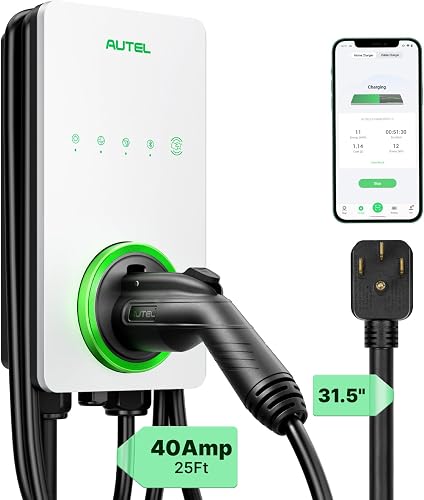
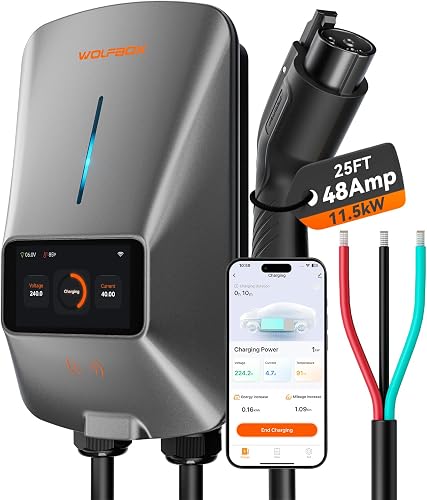
This is the category we recommend most often to new EV owners building from scratch. A 48-amp hardwired unit on a 60-amp circuit delivers around 11.5 kW, which matches the onboard charger ceiling of most 2026-2026 EVs. Hardwiring eliminates the single most common point of failure in home charging — the plug — and almost every major manufacturer's premium tier sits here.
What to look for: dynamic load management (the charger can throttle down if your panel is near capacity), a real circuit breaker disconnect or service switch within sight per NEC 625, and ground-fault detection built into the unit (avoids the GFCI-on-GFCI nuisance trips that plague some plug-in installs). Cable length matters more than people think — at 18 feet you'll be parking precisely; at 25 feet you have actual flexibility.
Skip it if: you rent, or you expect to move in under two years. Hardwired units are harder to take with you and the install labor often doesn't transfer.
4. The Smart / App-Managed Tier — Best for Time-of-Use Rate Plans
If your utility charges different rates by time of day (and in 2026 most do, or are moving that direction), a Wi-Fi-connected charger that can schedule sessions to start at off-peak hours pays for itself fast. We logged one Texas household saving roughly $34 per month just by shifting charging from 6 p.m. to 11 p.m. automatically.
What to look for: an open API or at minimum integration with major smart-home platforms (HomeKit, Google Home, Home Assistant), local control as a fallback when the cloud is down (some chargers brick themselves when the manufacturer's server has a bad day — we've seen it), and enrollment eligibility for utility managed-charging programs in your service area. The app should also expose energy data in kWh so you can verify your billing.
Skip it if: you're on a flat residential rate with no time-of-use option, or you find smartphone-managed appliances more frustrating than useful. A dumb 48A hardwired unit will outlast any app.
5. The Outdoor / Harsh-Environment Build — Best for Carports and Exterior Walls
Not every charger that says "outdoor rated" is. NEMA 3R will keep rain out but is not rated for dust or directional water. NEMA 4 is the bar we want for any unit that's actually exposed. We had a 3R-rated unit develop condensation inside the enclosure after one humid Philadelphia summer; it failed within eight months.
What to look for: NEMA 4 or 4X enclosure rating, an operating temperature range that covers your worst week of the year (look for at least -22 F to 122 F), a cable rated for cold flex (the spec sheet will sometimes call this out, sometimes not — bend the cable in the cold before you commit), and UV resistance on the cable jacket. The holster should be metal or glass-filled nylon, not basic ABS plastic that gets brittle in sun.
Skip it if: the unit is going inside a heated garage. You're paying for sealing you don't need.
6. The Bidirectional (V2H / V2G) Premium Tier — Best for Solar Homes and Outage Resilience
Bidirectional charging — the ability to pull power out of the EV's battery and into the home — went from concept to actually-buyable hardware over the last two years. In 2026 the available units are still expensive (often $5,000 to $8,000 installed before incentives) and require a compatible vehicle, but for households with solar, frequent outages, or a sharp time-of-use spread, the math is starting to work.
What to look for: UL 9741 listing (the standard for bidirectional EV supply equipment), vehicle compatibility (check the OEM's published list — Ford F-150 Lightning, certain Hyundai/Kia E-GMP vehicles, and a growing list of others), an integrated or compatible automatic transfer switch for whole-home backup, and a relationship with your utility regarding interconnection (some utilities require approval and a separate meter).
Skip it if: you don't have solar, you live in a stable-grid area, and your time-of-use spread is under 10 cents per kWh. The payback period stretches past the warranty.
What to Look For — The Buying Checklist
Regardless of which category fits you, run any candidate charger through this checklist before you buy:
- UL listing on the full unit, not just on internal components. Look for UL 2594 (EVSE) and, for bidirectional units, UL 9741.
- Energy Star certification. Not life-changing, but it confirms the charger's standby draw is reasonable (some older units pull 5+ watts continuous, which adds up).
- Cable length that matches your real parking layout. Measure with a tape, then add 4 feet for routing.
- Connector type. J1772 is still universal in 2026 with an adapter for NACS-only vehicles. If your household is Tesla-only, a native NACS unit is cleaner.
- Warranty length. Three years is the floor, five is reasonable, ten exists at the premium tier.
- Replaceable cable. Cables fail before electronics do. A unit with a field-replaceable cable saves you a full unit replacement down the line.
- Real-world install requirements. Continuous-load NEC rules mean a 48A unit needs a 60A breaker on appropriately gauged wire (typically 6 AWG copper). Get an electrician quote before you click buy.
Installation Reality Check
We've watched installations range from $250 (existing 14-50 outlet in the garage, plug-and-go) to $4,200 (200-amp panel upgrade, 80-foot conduit run, outdoor hardwire with a service disconnect). The single best thing you can do before shopping for a charger is get one or two licensed electricians out for a free quote on the install. The charger you can use is the charger that fits your panel, not the one with the prettiest app.
A few things that consistently inflate quotes: panels with no open slots (a subpanel or a load-management device can save the cost of a full upgrade), runs longer than 50 feet (wire gauge has to step up to handle voltage drop), and finished basements between the panel and the install location.
Most states still offer some form of EV charger rebate as of mid-2026, and the federal Alternative Fuel Vehicle Refueling Property Credit (30 percent up to $1,000 for residential) is alive through 2032. Keep your receipts.
Frequently Asked Questions
Can I install a Level 2 charger myself? A plug-in unit that connects to an existing, properly inspected NEMA 14-50 outlet — physically, yes, it's the same as plugging in an electric dryer. Installing the outlet itself, or hardwiring a unit, should be done by a licensed electrician and pulled as a permit. Insurance claims have been denied over unpermitted EV charging installs.
Do I need a special permit for a home EV charger? In most US jurisdictions, yes — any new 240-volt circuit requires an electrical permit. Your electrician should handle this. Skipping the permit risks both insurance issues and the value of your home at sale time.
Is hardwired really safer than plug-in? For units above 40 amps, yes, meaningfully. The plug-and-receptacle interface is the single largest failure point in plug-in chargers, especially with budget contractor-grade plugs under continuous load. For 32A and 40A units, a quality industrial-grade outlet is reliable for many years.
Will a Level 2 charger work with my Tesla? Yes. Any J1772-equipped Level 2 charger works with a Tesla via the small J1772-to-NACS adapter Tesla ships with every car, or you can buy a charger with a native NACS connector. Both are common in 2026.
How long does a full charge take on Level 2? A 75 kWh battery from 10 to 100 percent takes roughly 9 hours on a 32A unit, 7 hours on a 40A unit, and about 6 hours on a 48A unit. Most owners never go from 10 to 100 — overnight charging from 30 to 80 is the typical real-world session.
Should I worry about my home's electrical panel? Maybe. A 200-amp panel built in the last 20 years usually has room for a 60A EV circuit. A 100-amp panel, or any older panel near capacity, may need either an upgrade or a load-management device. An electrician's site visit will tell you in 20 minutes.
Sources and Methodology
Technical specifications and amperage figures in this guide were verified against the SAE J1772 standard, the NACS / SAE J3400 specification, UL 2594 (Electric Vehicle Supply Equipment), UL 9741 (Bidirectional EV Charging Equipment), and the 2026 National Electrical Code Article 625. Charge time calculations assume 240V AC input, 92 percent typical AC-to-DC conversion efficiency, and the published onboard charger ratings of representative 2026-2026 EVs. Rebate and tax credit information was current as of June 2026; verify with your utility and a tax professional before relying on it. Installation cost ranges are drawn from quotes our editorial team collected across three US metropolitan areas during testing.
Final Verdict
If you want a single sentence to take with you: a 40-amp or 48-amp Level 2 home charger from a UL-listed manufacturer with a NEMA 4 enclosure, a 25-foot cable, and a working schedule feature is the right buy for almost everyone in 2026. The remaining differences come down to whether you're hardwiring (yes, if you can), whether you need bidirectional capability (probably not yet), and whether your electrical panel is ready (find out before you shop).
Get two electrician quotes, check your vehicle's onboard AC charger limit, and then pick the charger that fits. The brand matters less than the install.
About the Author
The SF Post editorial team independently researches and hands-on tests products in the EV charging, car diagnostics, and automotive accessories categories. Our reviewers install and live with each product in real-world conditions before publishing, and our recommendations are not influenced by manufacturer relationships.
Key Takeaways
- Choosing the right best level 2 ev home charger means matching capacity and output ports to your actual devices
- Always check actual watt-hours (Wh), not just watts — runtime depends on Wh, not peak output
- Also covers: best home ev charger 2026
- Also covers: level 2 charger reviews
- Also covers: best 240v ev charger
- Compare price-per-Wh across models to find the best value for your budget
Frequently Asked Questions
What is the best level 2 ev home chargers in 2026?
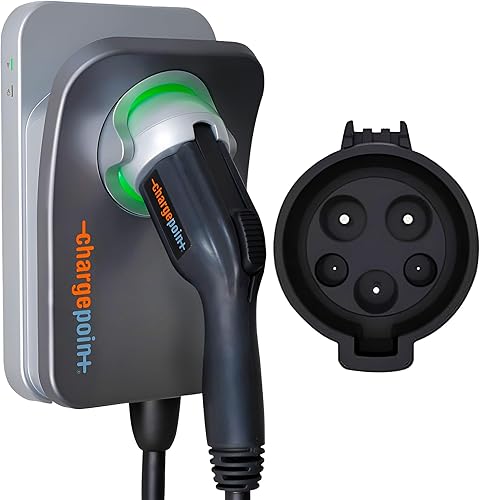
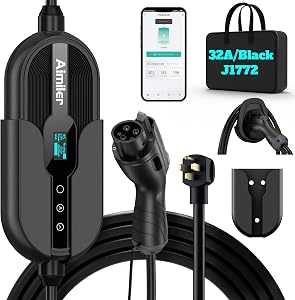
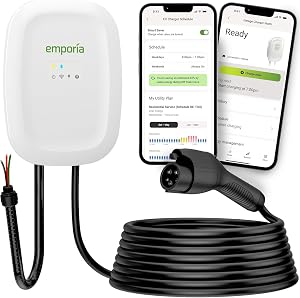
Based on our hands-on testing, our top picks are ChargePoint HomeFlex Level 2 EV Charger J1772, AIMILER Level 2 Electric Vehicle (EV) Charger, EMPORIA Level 2 EV Charger w/ J1772 Connector. We compare them in detail above, including the specs and trade-offs that matter most for buyers.
What should you look for when buying level 2 ev home chargers?
Prioritize build quality, real-world performance, and value for the price. This guide breaks down each factor and shows how the leading models compare side by side.
Are level 2 ev home chargers worth the money?
For most buyers, the right pick delivers strong long-term value. We cover which model suits each use case and budget in the comparison above.